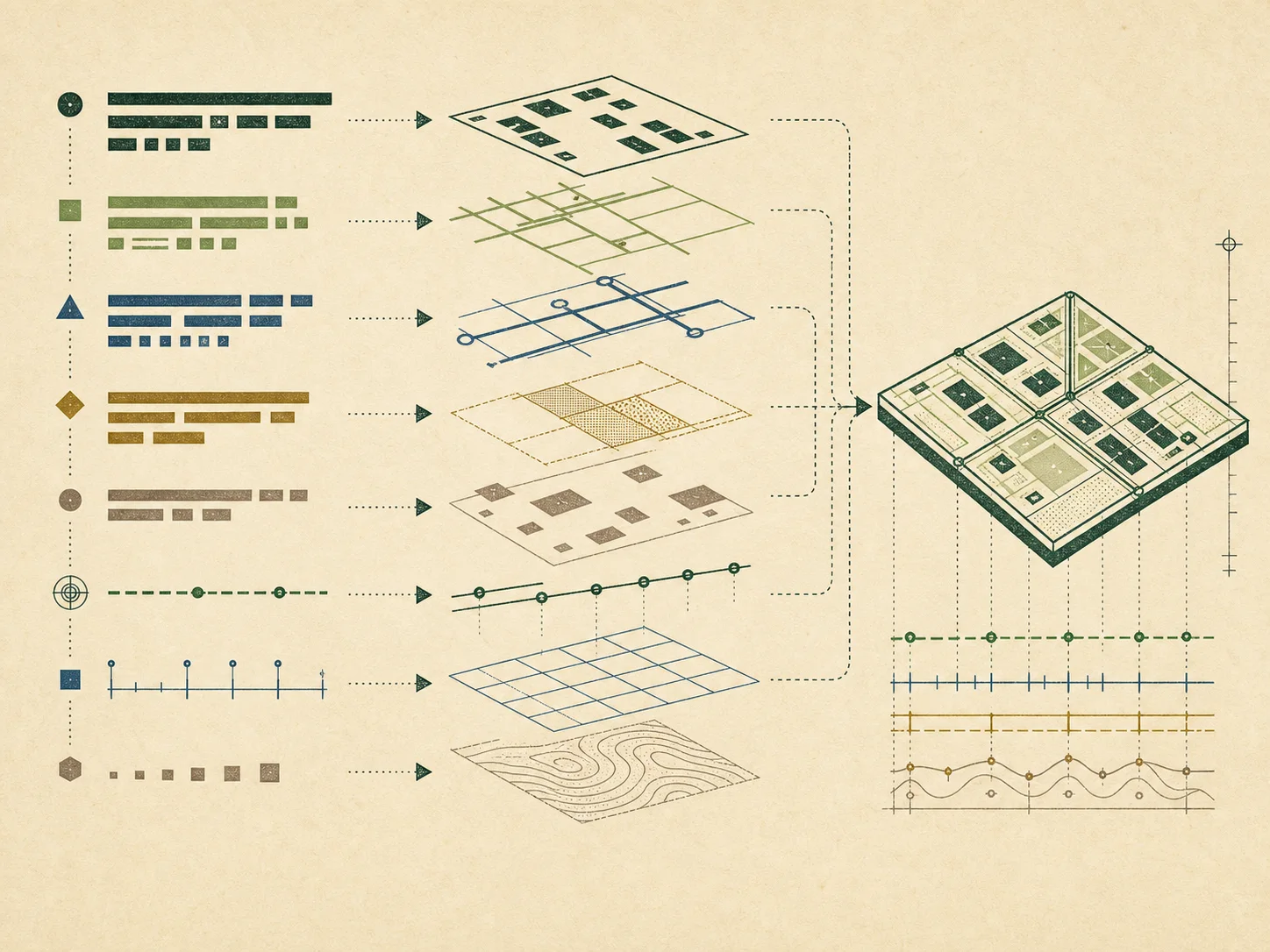
Start with the smallest supportable claim
Every page begins by asking what fact is needed and which public office maintains it. A state authority can support the statewide office model, while a county-specific official page is needed for a local fee, portal feature, or parcel-number convention. One source is not stretched to support a neighboring jurisdiction or a different record type.
When evidence is incomplete, Parcelway narrows the wording. “Use the official directory to verify online access” is preferable to claiming that a search exists. A county-specific fee is omitted until a current official schedule supports it. A parcel identifier is described as locally formatted rather than illustrated with a fabricated number. This restraint is an editorial feature, not missing polish.
Capture provenance and time
Structured data files store the source URL, agency title or authority, and verified-on date. County rows also preserve the Census FIPS code, population estimate, and rank used for coverage. State rows separate property-tax or assessment authority from the geospatial resource so that one link is not presented as maintaining every layer.
The public page repeats the verification date and source list. Dynamic search URLs are not treated as durable citations; the office landing page is preserved. Dates are named precisely: assessment year, effective date, recording date, posting date, GIS update, and retrieval date are never silently collapsed into a generic “current” label.
Validate the built site, not only the source code
The production build is crawled as static HTML. Validation checks placeholders, prohibited legacy brand terms, duplicate titles and descriptions, missing canonicals, broken internal links, missing image alternatives, pages below the required word count, absent verification dates, thin county records, prohibited owner-search forms, and captions that could make generated art look like a real record.
Link checking runs against the final build directory. Sitemaps are generated from the same route inventory and split into shards beneath the protocol limit. Lighthouse is run against representative mobile pages for performance and accessibility. Deployment happens only after these gates pass, and live checks compare canonical files, response codes, robots directives, and selected page content.
Corrections and re-verification
A reader should report the affected URL, exact field, public office, official supporting link, and the date observed. A correction is evaluated against the maintaining agency rather than a third-party copy. When two agencies conflict, Parcelway records the conflict or defers to the office responsible for the exact record type.
This release does not expose a live intake form or collect personal information. Until a public editorial mailbox is configured, use the official agency for urgent record questions. Parcelway’s contact page explains the evidence to prepare for a future editorial correction channel.